
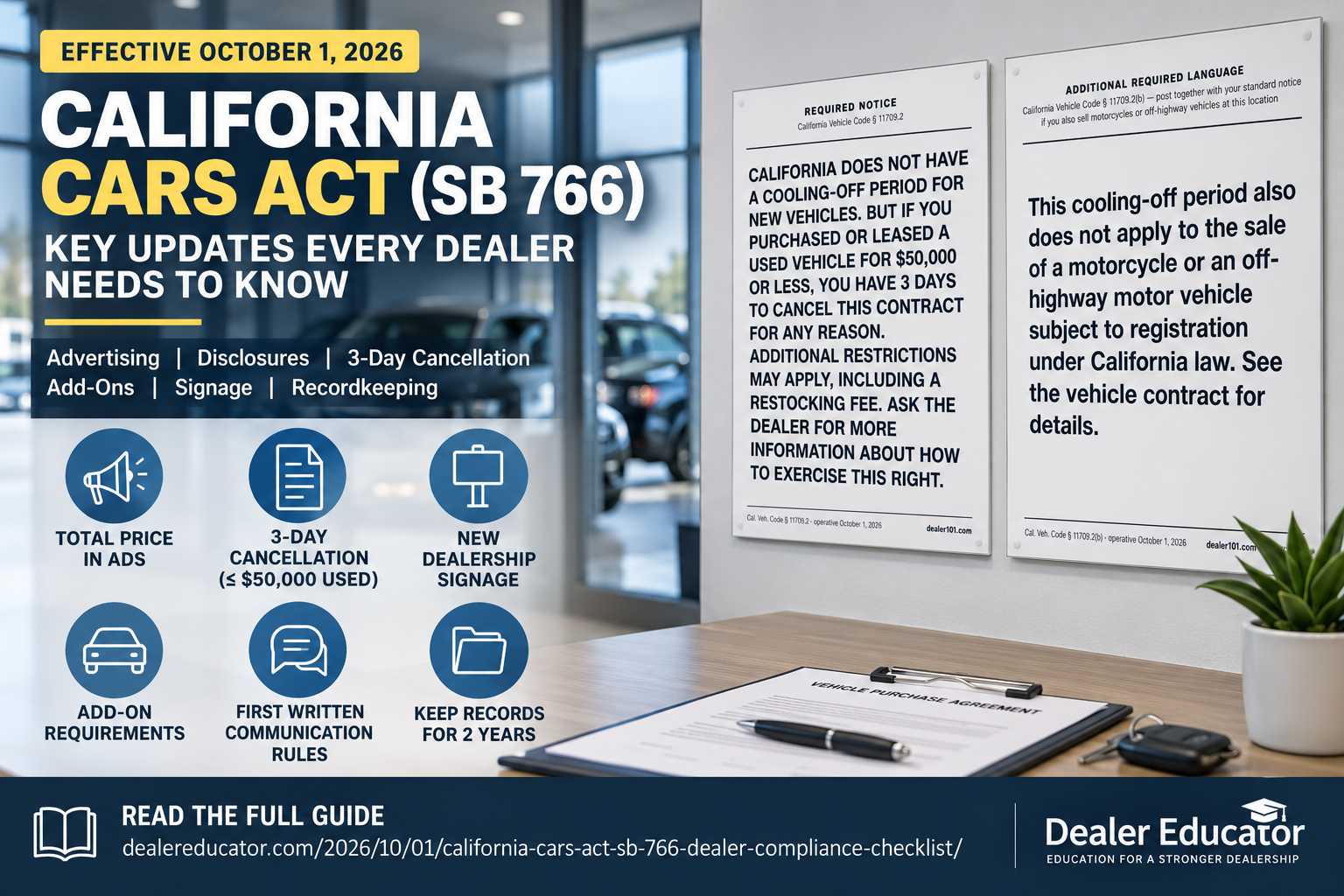

California CARS Act (SB 766): 2026 Compliance Checklist for Auto Dealers
California dealers have a major new set of compliance requirements. Effective October 1, 2026, Senate Bill 766 created the California Combating Auto Retail Scams Act, commonly called the California CARS Act.
The law changes several everyday dealership practices, including vehicle advertising, written communications with customers, add-on products, used vehicle cancellation rights, required dealership signage, contracts, and record retention.
For retail dealers, this is not simply a paperwork update. Sales staff, finance personnel, internet leads, advertising systems, and dealership forms may all need to be reviewed.
California DMV has also issued Occupational Licensing Industry News Memo OLIN 2026-10 explaining the new requirements to licensed dealers.
View California DMV OLIN 2026-10
What Is the California CARS Act?
SB 766 added the California Combating Auto Retail Scams Act to the California Civil Code. The new provisions became operative October 1, 2026.
The law regulates how dealers advertise prices, communicate with consumers, sell optional products, represent financing terms, and handle cancellations of qualifying used vehicle transactions.
DMV explains that the Act generally applies to licensed California dealers engaged in covered retail sales or leases of light-duty vehicles under 10,000 pounds. Certain transactions are excluded, including qualifying wholesale transactions, some fleet transactions, qualifying commercial purchasers, and vehicles with a gross vehicle weight rating of 10,000 pounds or more.
1. Advertise the Vehicle’s Total Price
One of the biggest changes affects vehicle pricing.
When an advertisement identifies a specific vehicle for sale, the dealer must clearly and conspicuously disclose the vehicle’s total price. The requirement also applies when an advertisement states a monetary amount or financing term for a specific vehicle.
The law defines total price generally as the vehicle’s complete selling price before specified taxes and statutory fees. Dealer price adjustments and items already installed on the vehicle must be included. A dealer also cannot reduce the advertised total price by assuming that the customer qualifies for a rebate.
Review These Advertising Channels
- Dealership websites
- Third-party vehicle listings
- Online marketplaces
- Social media advertising
- Paid search advertisements
- Email campaigns
- Text-message campaigns
- Printed advertisements
- Vehicle-specific financing promotions
The practical rule is simple: if you are promoting a specific vehicle and discussing its price or financing terms, make sure the required total price is displayed clearly.
2. The First Written Response to a Customer Can Trigger the Rule
The CARS Act does not stop at public advertising.
If a consumer contacts the dealership about a specific vehicle, the dealer’s first written response concerning that vehicle must disclose the total price at least once.
That can include an email, text message, or other written communication. Dealers must retain the qualifying first communication for at least two years and provide a copy to the consumer upon written request.
Internet Departments Should Update Templates
Dealers should review automated lead responses and CRM templates now.
A salesperson responding only with a message such as, “Yes, the vehicle is still available. What time would you like to come in?” may need a different workflow if that communication falls within the statute’s requirements for the first written communication concerning the vehicle.
Sales and internet staff should not assume that pricing disclosure begins only after a customer arrives at the dealership.
3. Used Vehicles $50,000 or Less Now Have a 3-Day Right to Cancel
The previous California system required qualifying dealers to offer an optional, paid two-day contract cancellation option on certain used vehicles.
SB 766 repealed that system.
For covered transactions beginning October 1, 2026, a dealer generally cannot sell or lease a used vehicle at retail for $50,000 or less without providing the buyer or lessee a three-day right to cancel. The dealer cannot charge the customer simply for receiving the right to cancel.
How the Three Days Are Calculated
The statute defines the three-day period as three calendar days beginning on the calendar day after the purchase or lease is executed.
If the third day falls on a day when the dealership is closed to the public, the cancellation period continues until the next day the dealership is open.
The right expires at the dealership’s close of business on the final applicable day.
The 400-Mile Limit
The cancellation right does not apply if the vehicle has been driven more than 400 miles between execution of the agreement and the attempted cancellation.
This makes mileage documentation at delivery particularly important.
4. Dealers May Charge a Restocking Fee
The three-day cancellation right does not mean every returned vehicle must be accepted without cost to the customer.
The statute permits a restocking fee equal to 1.5% of the vehicle’s sale price, subject to a minimum of $200 and a maximum of $600.
If the vehicle has been driven more than 250 miles, the dealer may additionally charge $1 per mile for each mile over 250, up to an additional $150.
There are additional rules concerning shipping costs, refunds, and how the fee is collected, so dealers should make sure their cancellation forms and procedures calculate the amount correctly.
5. The Vehicle Still Has to Be Returned Properly
The three-day right to cancel is subject to conditions.
Among other requirements, the customer generally must personally return the vehicle to the selling or leasing dealer during business hours. The vehicle must be free from unauthorized liens and returned in substantially the same condition as delivered, allowing for reasonable wear and tear and certain defects or mechanical problems not caused by the customer.
The customer must also return applicable cash or property received in connection with the transaction.
Dealers should document the vehicle’s condition and mileage at both delivery and return.
A simple signed delivery inspection can become extremely useful if there is later a disagreement over damage or mileage.
6. A Separate 3-Day Cancellation Disclosure Is Required
For a qualifying used vehicle, the dealer must provide a separate disclosure titled:
3-Day Right to Cancel Used Car Purchase or Lease
The disclosure must contain information including:
- Dealer and customer information
- Vehicle description and VIN
- The deadline for exercising the cancellation right
- How the restocking fee is calculated
- The 400-mile limitation
- Vehicle-return requirements
- Trade-in rules
- Required cancellation procedures
If the transaction is primarily negotiated in certain languages covered by California Civil Code Section 1632, the required disclosure must also be provided in that language.
Dealers should make sure their forms provider or dealer management system has updated forms designed for the October 1, 2026 requirements.
7. Purchase and Lease Agreements Also Need Updated Language
SB 766 also changes the disclosure that appears on the first page of applicable vehicle purchase and lease agreements.
The new disclosure distinguishes between new vehicles, which generally do not receive this statutory three-day cooling-off right, and qualifying used vehicles priced at $50,000 or less.
Dealers should not continue using contract forms designed around the former two-day cancellation-option law.
8. Replace the Old Cooling-Off-Period Sign
This is one of the most visible changes dealers need to make.
Beginning October 1, 2026, California Vehicle Code Section 11709.2 requires dealers to conspicuously display a physical notice in at least 36-point type in:
- Each sales office where written terms of specific transactions are discussed
- Each sales cubicle where those terms are discussed
- Each room where sales or lease contracts are regularly executed
The new notice explains that California does not provide a cooling-off period for new vehicles but provides qualifying purchasers or lessees of used vehicles priced at $50,000 or less three days to cancel, subject to restrictions and possible restocking fees.
Dealers should use the exact statutory language contained in California Vehicle Code Section 11709.2 rather than creating their own version of the notice.
If the dealership also sells or leases motorcycles or qualifying off-highway vehicles at the same location, Section 11709.2 requires additional language explaining that the cancellation right does not apply to those vehicles.
Signage Compliance Check
Walk through your dealership and identify every location where:
- Price negotiations occur
- Written deal terms are shown to customers
- Finance terms are discussed
- Purchase agreements are signed
- Lease agreements are signed
Do not assume one sign at the front desk satisfies the requirement.
9. Add-On Products Receive New Scrutiny
The CARS Act establishes additional rules for dealership add-ons.
When a dealer makes a written representation during negotiations about an add-on product or service, the dealer must clearly disclose in writing that the add-on is not required and that the consumer may purchase or lease the vehicle without it.
The law also prohibits charging customers for add-ons that do not provide a benefit to the buyer, vehicle, or transaction.
Examples identified in the statute include certain:
- Nitrogen tire products that fail the statutory purity requirement
- Products that provide no applicable coverage
- Noncompliant GAP products
- Service contracts rendered void by known preexisting conditions
- Oil-change products for electric vehicles
- Catalytic-converter marking for vehicles without catalytic converters
- Surface-protection products that void the manufacturer’s paint warranty
The law does not prohibit legitimate optional products that the customer selects and from which the customer can potentially benefit.
10. Written Monthly-Payment Quotes Need More Information
Sales staff should also be careful when quoting monthly payments in writing.
When a written representation during negotiations states a monthly payment, the dealer generally must disclose the total amount the consumer will pay if all scheduled payments are made.
If the calculation assumes a down payment, trade-in value, or other consideration from the consumer, that amount must also be disclosed.
If the dealer makes a written comparison emphasizing a lower monthly payment, the law also requires disclosure that lower monthly payments often increase the total amount paid to purchase or lease the vehicle.
This is another area where text-message templates, payment calculators, and CRM workflows should be reviewed.
11. Dealers Cannot Materially Misrepresent Key Transaction Information
The CARS Act specifically prohibits material misrepresentations involving a number of dealership activities.
These include representations concerning:
- Purchase, financing, and lease costs or terms
- Add-on costs, limitations, or benefits
- Whether the transaction is a sale or lease
- Vehicle availability at a communicated total price
- Financing preapproval or guarantees
- Information contained in a credit application
- Down payments and trade-ins if a transaction does not close
- Trade-in payoff obligations
- Remedies if an advertised or communicated price is not honored
- Government affiliation or endorsement
- Repossession rights
- Restrictions involving movement of the vehicle
- Required CARS Act disclosures
The statute defines material information as information likely to affect a person’s decision or conduct concerning the goods or services.
12. Keep CARS Act Records for at Least Two Years
Recordkeeping is a major part of SB 766.
Dealers subject to the Act must create and retain records needed to demonstrate compliance for two years from the date the record is created.
Required records can include:
- Vehicle advertisements
- Total-price communications
- Relevant first communications with customers
- Signed purchase documents
- Financing documents
- Lease documents
- Written customer communications associated with completed or attempted transactions
- Add-on documentation
- Service contracts and GAP agreements
- Proof of required add-on payments
- Cancellation requests
- Proof of refunds
- Trade-in return documentation
- Certain written complaints and inquiries
The records may generally be maintained electronically or in another legible form consistent with the dealer’s normal recordkeeping system.
13. Handle Cancellations Quickly
When a customer properly exercises the statutory cancellation right, the dealer generally must cancel the transaction and provide the required refund no later than 48 hours afterward, less authorized deductions.
Special timing rules apply when the customer’s original payment has not yet cleared or been verified.
Trade-ins deserve particular attention.
If a dealer has already sold the customer’s trade-in or initiated the process of transferring title, the statute contains rules governing the amount that must be returned to the customer and documentation that must be provided.
For that reason, dealerships may want to reconsider how quickly qualifying trade-in vehicles are wholesaled or transferred during the three-day cancellation window.
California CARS Act Dealer Compliance Checklist
- Replace the old two-day cancellation signage.
- Post the new Section 11709.2 notice in every required sales and contracting area.
- Use at least 36-point type for the required physical signage.
- Add the additional motorcycle or OHV language when applicable.
- Update purchase and lease agreements.
- Obtain the new separate three-day cancellation disclosure.
- Train employees on the $50,000 used-vehicle threshold.
- Record vehicle mileage accurately at delivery.
- Create a return-condition inspection procedure.
- Update restocking-fee calculations.
- Review website and third-party vehicle advertisements.
- Include the total price in qualifying vehicle advertisements.
- Update CRM, email, and text-message templates.
- Make sure qualifying first written customer responses contain the required total price.
- Review all add-on products for actual customer benefit.
- Train staff to describe add-ons as optional when required.
- Review written monthly-payment quoting procedures.
- Retain CARS Act compliance records for at least two years.
- Create a written process for cancellation requests, refunds, and returned trade-ins.
- Train every salesperson, finance employee, and internet lead representative on the new rules.
Training Tip for California Dealers
The CARS Act touches multiple parts of a dealership at the same time.
A dealer may have compliant contracts but still create a problem through an outdated website price, an automated text response, an old wall sign, or an improperly handled cancellation.
Management should therefore treat SB 766 as a dealership-wide compliance update, not just a finance-office form change.
Run a test customer through your entire sales process, starting with the online advertisement and ending with the completed deal jacket. Review every communication, form, disclosure, and sign the customer encounters.
Bottom Line
The California CARS Act represents one of the most significant recent changes to California vehicle dealer compliance.
Beginning October 1, 2026, covered dealers must account for new total-price rules, first-communication disclosures, a mandatory three-day cancellation right for qualifying used vehicles, updated dealership signage, new add-on restrictions, and expanded two-year recordkeeping requirements.
The dealerships most prepared for the change will be the ones that update advertising, CRM systems, signage, forms, employee training, and deal-jacket procedures together rather than treating each requirement separately.
Official California Sources
-
California Legislature: SB 766, California Combating Auto Retail Scams Act
-
California DMV: California Combating Auto Retail Scams Act
-
California DMV: OLIN 2026-10, Implementation of CARS Act (SB 766)
This article is provided for educational purposes and is not legal advice. Dealers should review the applicable statutes, DMV guidance, and their own legal or compliance resources when updating dealership procedures.


