
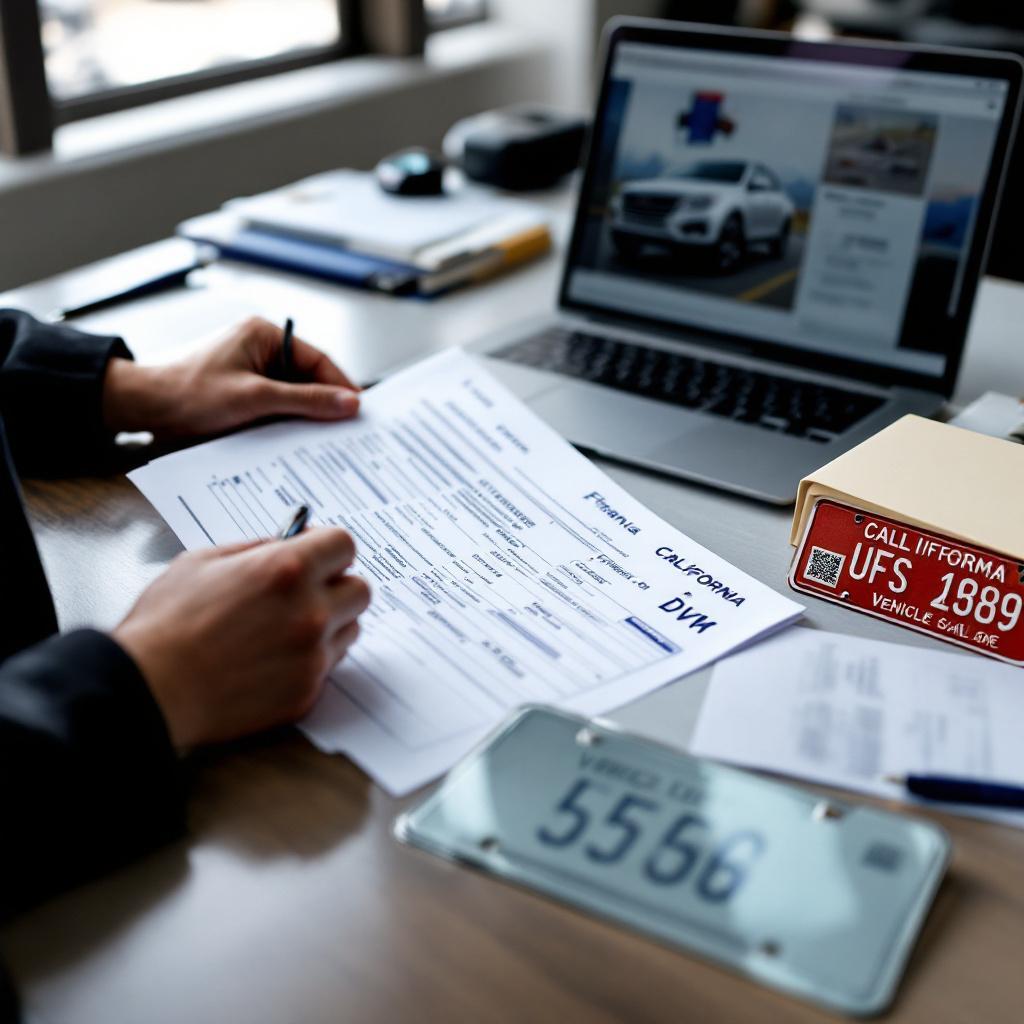

DealerEducator.com students frequently ask how California dealer Quick Tags works in real life: how you electronically report a retail sale, print a compliant Report of Sale (REG 51) and Temporary License Plate (TLP) at delivery, and keep records that hold up in an audit. This guide walks through the practical workflow taught in Dealer Educator’s California dealer pre-licensing and renewal courses, plus a few DMV manual citations you can bookmark for compliance.
What “Quick Tags” does for California dealers
Quick Tags is part of California DMV’s electronic reporting environment that lets eligible dealers report retail vehicle sales electronically and print the required paperwork at the time of sale. In Dealer Educator training, the key compliance takeaway is simple: for retail deliveries, you should be set up to generate the REG 51 and (when applicable) the TLP immediately—before the vehicle leaves your control.
Two common ways dealers access the system
- Quick Tags access (as described in Dealer Educator materials) is obtained through the DMV’s program contact process.
- Authorized “first-line service provider” platforms can also be used to transmit sale data and print DMV-required outputs.
How to enroll in California dealer Quick Tags (high-level)
Dealer Educator course guidance describes enrollment by emailing the Quick Tags program contact with basic dealership information (dealership name, owner name, email, and phone). After approval, training and access are provided through follow-up communication.
Many dealerships operate through an authorized first-line service provider that integrates with DMV requirements. Examples used in Dealer Educator course references include:
- Dealertrack Registration and Titling Solutions
- Automated Vehicle Registration Service, Inc. (AVRS)
- American Driving Records, Inc. (SambaSafety)
The retail delivery workflow: transmit the sale, print REG 51, and issue the TLP
A clean delivery workflow protects your customer and your license. Here’s the practical, compliance-first sequence that Dealer Educator teaches for retail sales:
- Enter the sale data in your DMV-approved electronic system (Quick Tags or authorized provider).
- Print the Report of Sale (REG 51) and confirm all vehicle/purchaser fields are complete and readable.
- Print the Temporary License Plate (TLP) (when applicable) and verify it matches the vehicle being delivered.
- Mount/affix the TLP properly before the vehicle leaves (see mounting checklist below).
- Give the buyer the customer copy of the Report of Sale for display as instructed by your system’s REG 51 print format, and retain your dealer copies for your deal jacket.
What a compliant Temporary License Plate (TLP) must show
Dealer Educator training emphasizes that the TLP is not “just a printout”—it is a compliance document that must be legible and traceable to the specific transaction. In the Dealer Educator course materials, a TLP includes these elements:
- Temporary License Plate number
- Report of Sale (ROS) number
- Vehicle Identification Number (VIN)
- Vehicle make and model
- Expiration date set 90 days from the date of sale
- A QR code embedded with validation information
Paper and printer durability expectations
Dealer Educator materials note that TLPs must be produced using DMV-authorized, weather-resistant paper and a durable (typically inkjet) print process suitable for varied weather conditions. Confirm exact hardware and paper requirements with your system provider so your printed plate remains readable in real driving conditions.
TLP mounting and “before it leaves the lot” checks
One of the most preventable causes of roadside issues—and dealership complaints—is a TLP that’s unreadable, incorrectly attached, or doesn’t match the delivered vehicle.
Use this delivery checklist:
- Match identifiers: TLP plate number/ROS number/VIN match the deal and the vehicle.
- Confirm expiration: 90-day expiration prints correctly.
- Legibility: no smears, streaks, or faded printing; QR code is intact.
- Mount securely: Dealer Educator guidance emphasizes fastening at all four corners when mounting.
- Front/rear placement: when the transaction requires it, ensure the temporary plate is placed as instructed for the vehicle configuration.
Lost or damaged TLPs: reprint immediately
Dealer Educator best practice is straightforward: if a temporary plate is lost or damaged, reprint a replacement immediately through your electronic reporting system. Treat replacement printing as an accountable event and document it in the deal file.
REG 51 accuracy: how to reduce rejects and audit exposure
The REG 51 (Report of Sale—Used Vehicle) is an accountable DMV document and should be handled like one. Errors can trigger processing delays, rejected submissions, and audit questions.
Corrections must be done the DMV way
The California DMV Vehicle Industry Registration Procedures Manual explains that corrections on a REG 51 are acceptable, but they must be properly acknowledged by the dealer or authorized representative who signed the dealer certification (they must “OK” and initial the correction). If the error is in the odometer disclosure section, DMV requires a separate odometer disclosure on REG 262 and a Statement of Facts (REG 256) explaining why it’s separate. See DMV guidance here: Corrections on the Report of Sale—Used Vehicle (REG 51).
Voids vs. rollbacks (don’t “void” the wrong transaction)
DMV guidance warns dealers not to mark a REG 51 “void” if the buyer took possession and later returned the vehicle; those scenarios are handled differently (commonly discussed as rollbacks). DMV also explains retention requirements for voided documents. Reference: DMV Vehicle Industry Registration Procedures Manual—Transfers.
Recordkeeping that supports audits (and makes your life easier)
Dealer Educator courses stress that your compliance is only as strong as your paperwork trail. Build a repeatable “delivery jacket” process around your REG 51 and TLP outputs.
Practical audit-ready recordkeeping steps
- Keep a complete deal jacket with the printed REG 51, copies/support for TLP issuance, and any correction notes.
- Store accountable forms securely and limit access to trained staff.
- Document exceptions (reprints, customer complaints about damage/loss, delivery delays, unwind/rollback activity).
- Use consistent internal logs (for example, a simple TLP reprint log tied to stock/unit number) so you can answer “who printed what and why” quickly.
Keep void documentation together
DMV’s manual instructs dealers to retain all copies of a voided report of sale and the supporting Statement of Facts (REG 256) with the book copy at the dealer’s primary business location so it’s available for audit. Source: DMV Vehicle Industry Registration Procedures Manual—Report of Sale (Used Vehicles).
Quick reference table: TLP and REG 51 do’s
| Task | Best-practice standard (Dealer Educator) | Why it matters |
| Print TLP at delivery | Print through Quick Tags/authorized provider before release to buyer | Reduces unregistered operation risk and delivery disputes |
| Verify required TLP fields | Plate #, ROS #, VIN, make/model, 90-day expiration, QR validation | Supports enforcement validation and prevents mismatch errors |
| Mount securely | Fasten at all four corners; confirm placement appropriate for vehicle | Prevents plate loss and legibility issues |
| Fix REG 51 errors correctly | Use DMV-approved correction method; document odometer fixes properly | Avoids rejects and keeps audit trail clean |
| Reprint lost/damaged TLP | Reprint immediately; note the reprint in your file/log | Maintains customer compliance and protects dealership |
Bottom line for the CA DMV dealer test (and real operations)
If you’re studying for the CA DMV dealer test or tightening compliance for renewal, remember the exam-friendly framework Dealer Educator teaches:
- Report retail sales electronically using DMV-approved systems.
- Print the REG 51 and TLP at the time of sale/delivery, and verify every required field.
- Mount the TLP properly before the vehicle leaves.
- Reprint immediately if a temporary plate is lost or damaged.
- Retain accountable documents in an organized, audit-ready way.
Sources
- California DMV — Vehicle Industry Registration Procedures Manual: Corrections on the Report of Sale—Used Vehicle (REG 51)
- California DMV — Vehicle Industry Registration Procedures Manual: Transfers
- California DMV — Vehicle Industry Registration Procedures Manual: Report of Sale (Used Vehicles)
- Dealertrack Registration and Titling Solutions
- Automated Vehicle Registration Service Inc. (AVRS)
- American Driving Records Inc. (SambaSafety)


