
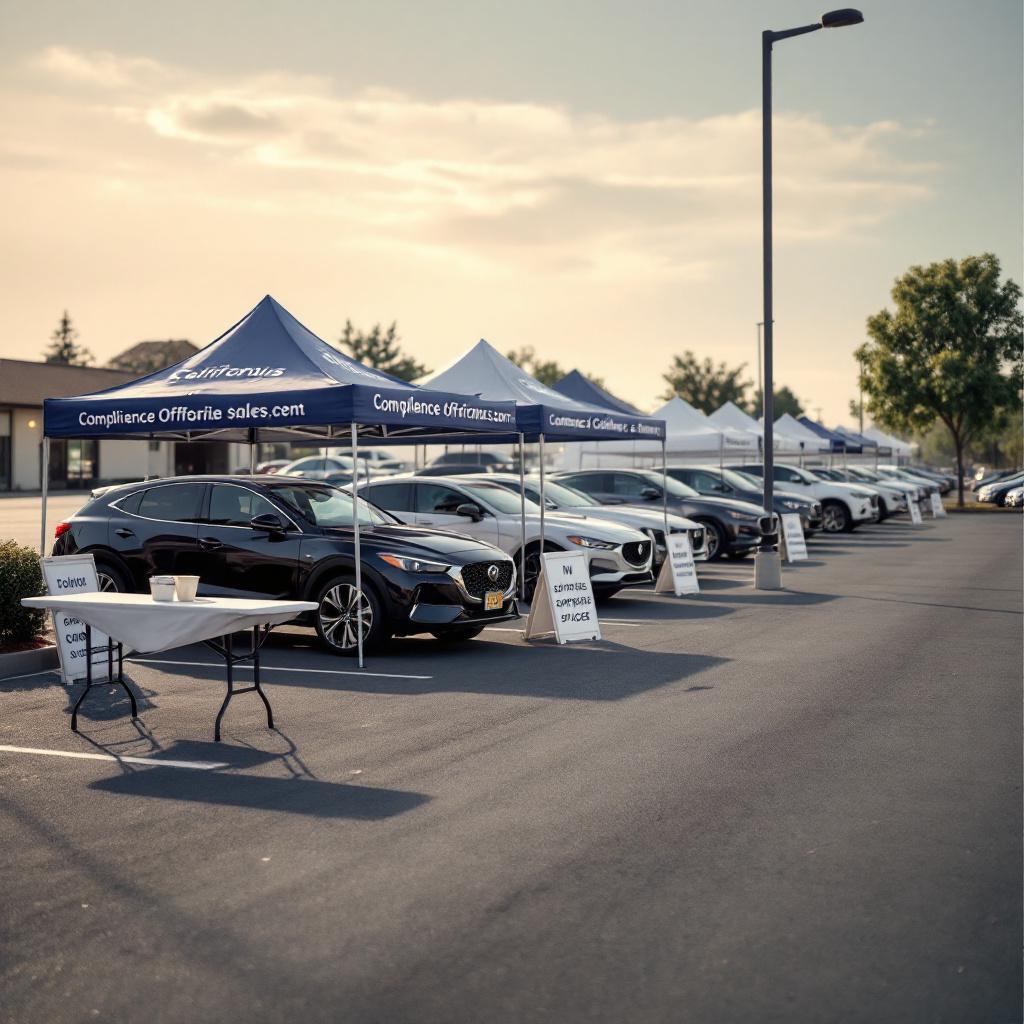

Running a compliant offsite sales event in California starts with one key question: are you selling, or only displaying? This California DMV offsite sale permit (OL 73/OL 73A) checklist breaks down when you need a temporary branch permit versus a display-only setup—and how to avoid the common violations DMV investigators cite at temporary locations.
1) Decide: display-only vs. temporary branch (sales) vs. permanent branch
Display-only (no sales activity)
Dealer Educator training explains that a dealer may display vehicles at certain public events for a limited time without obtaining a branch license, as long as no sales are offered, solicited, or transacted at the display site. That means no taking deposits, no writing up deals, and no actions that bind a sale.
Dealer Educator also notes two common display-only rules students miss:
- The event must be open to all dealers (not an exclusive, dealer-restricted event).
- Each displayed vehicle should have a sign (letters at least 3 inches high) with the dealer’s name, address, and the statement: “NO SALES PERMITTED, OR DEPOSITS ACCEPTED AT THIS LOCATION”.
For the legal basis of display-only events and sign identification, see California Vehicle Code section 11709(b)–(c) (via the California Legislative Information site): https://leginfo.legislature.ca.gov/faces/codes.xhtml.
Temporary branch/offsite sales (sales activity occurs)
If you will negotiate, accept deposits, execute contracts, or otherwise conduct sales at an address other than your principal place of business, Dealer Educator teaches you must obtain DMV approval for that temporary location using the appropriate application (OL 73 or OL 73A). Operating sales from an unlicensed address is a fast way to get cited or shut down.
Permanent branch (ongoing sales location)
If you want an ongoing second location, that is typically handled as a branch location modification to your occupational license (not a temporary permit). Requirements can include a new lease/rental agreement and DMV photo documentation, and you should plan ahead for local approvals where applicable.
2) OL 73 / OL 73A application checklist (before the event)
Use this planning checklist from Dealer Educator’s pre-licensing and renewal coursework.
- Pick the correct form:
- OL 73 for standard offsite/temporary branch sales events (vehicles, motorcycles, ATVs).
- OL 73A for recreational vehicle dealers (motorhomes/recreational trailers), typically for events lasting 30 days or less.
- Submit the application at least 10 days before the event so DMV has time to process it (Dealer Educator emphasizes this timing requirement).
- Pay the required fee (Dealer Educator course materials commonly reference a $70 fee for a temporary branch/offsite sale permit).
- Include site control documentation: a copy of the lease/rental agreement for the event location, or a promoter notice/contract showing the dealer’s right to occupy the space for sales.
Quick “pre-flight” table
| Item | What DMV expects (per Dealer Educator training) | Best practice |
| Correct application | OL 73 or OL 73A | Confirm your dealer type and what you’re selling before submitting |
| Lead time | Submit at least 10 days in advance | Submit earlier to account for corrections or follow-up requests |
| Fee | Temporary branch/offsite sale fee (commonly $70) | Keep proof of payment with the event file |
| Location documentation | Lease/rental agreement or promoter notice/contract | Make sure the contract clearly identifies your assigned space |
3) On-site setup rules (day of the event)
Once you arrive on-site, compliance is mostly about what is posted and what is clearly separated. Dealer Educator’s checklist focuses on these areas:
Required dealer sign (name and address)
- A dealer sign must be posted at the location with the dealer’s licensed name and address.
- Dealer Educator training specifies the sign should be at least 2 square feet on each side and the lettering must be large enough to be read from 50 feet.
Signage rules for vehicle dealers are also addressed in California Code of Regulations, Title 13 (see the California government regulatory site): https://govt.westlaw.com/calregs and the Office of Administrative Law: https://oal.ca.gov. (Always verify the current section that applies to your dealer type and location.)
Post the temporary operating permit
Dealer Educator emphasizes that the DMV-issued temporary operating permit must be visibly posted at the event. If it’s not displayed, it’s one of the most common reasons a site gets cited.
Designate a clear “office” area
Set up a clearly marked area that functions as your temporary office (for example, a table, RV, or temporary structure). This is where customers can review paperwork and where required notices and licenses should be visible.
Display dealer and salesperson licenses
At the sale site, Dealer Educator teaches you must display your dealer license and all salesperson licenses in a visible place. Missing salesperson license display is a common citation at offsite events.
Post required consumer notices
Dealer Educator training highlights required postings that commonly apply at temporary branch/offsite sales locations, including:
- “No Cooling-Off Period” notice
- “3rd Party Inspection Notice”
- “Right to a Spanish Contract Translation” notice (when applicable)
Vehicle display area: separation and parking control
- Separate your inventory visibly and physically from other sellers/dealers at the same event.
- Keep public parking out of the designated vehicle display area.
4) Common offsite violations (and how to prevent them)
Dealer Educator’s courses repeatedly identify the same preventable issues that lead to citations or shutdowns at temporary branch events. Use this as your “avoid getting written up” list:
- Missing dealer sign (dealer name and address not posted).
- Temporary branch permit not displayed prominently at the site.
- Salesperson license not displayed at the temporary location.
- One salesperson selling for multiple dealers at the same temporary sale (not allowed).
- Inventory from different dealers not clearly separated.
- Non-compliant advertising for the event (missing required disclosures or otherwise failing applicable rules).
- Personal vehicles (customer/employee cars) parked in the area reserved for vehicles offered for sale.
Prevention tips that work in the real world
- Print a “posting packet” (permit + dealer license copy + salesperson license copies + required notices) and keep a duplicate in the deal jacket box.
- Do a signage walk-through before doors open: can the dealer sign be read from the required distance, and does it show the licensed name and address?
- Mark your display area with cones/tape and assign a staff member to keep public parking out.
- Separate inventory by dealer with physical spacing and clear markers to avoid “mixed inventory” violations.
- Advertising review rule: don’t run event ads until your compliance person confirms required disclosures and correct dealership identity.
5) Audit-ready file: what to keep after the event
If DMV visits, or if you later need to prove your compliance, an organized file helps. Dealer Educator students are encouraged to keep:
- Copy of the submitted OL 73/OL 73A application and proof of submission timing
- Proof of fee payment
- Lease/rental agreement or promoter contract/notice
- Photos of the setup (dealer sign, permit posted, office area, inventory separation)
- Copies of event advertising used
6) Quick summary checklist (printable)
- Confirm whether the event is display-only or sales.
- If sales: submit California DMV offsite sale permit (OL 73/OL 73A) paperwork at least 10 days in advance, include the site agreement/promoter notice, and pay the fee.
- Bring and post: dealer sign (name/address), temporary permit, dealer & salesperson licenses, and required consumer notices.
- Control the lot: separate inventory, keep public parking out, and prevent cross-selling for multiple dealers.
- Keep an audit file with proof + photos.
Sources
- California Legislative Information (California Vehicle Code): https://leginfo.legislature.ca.gov/faces/codes.xhtml
- California Office of Administrative Law (California regulations access): https://oal.ca.gov


