
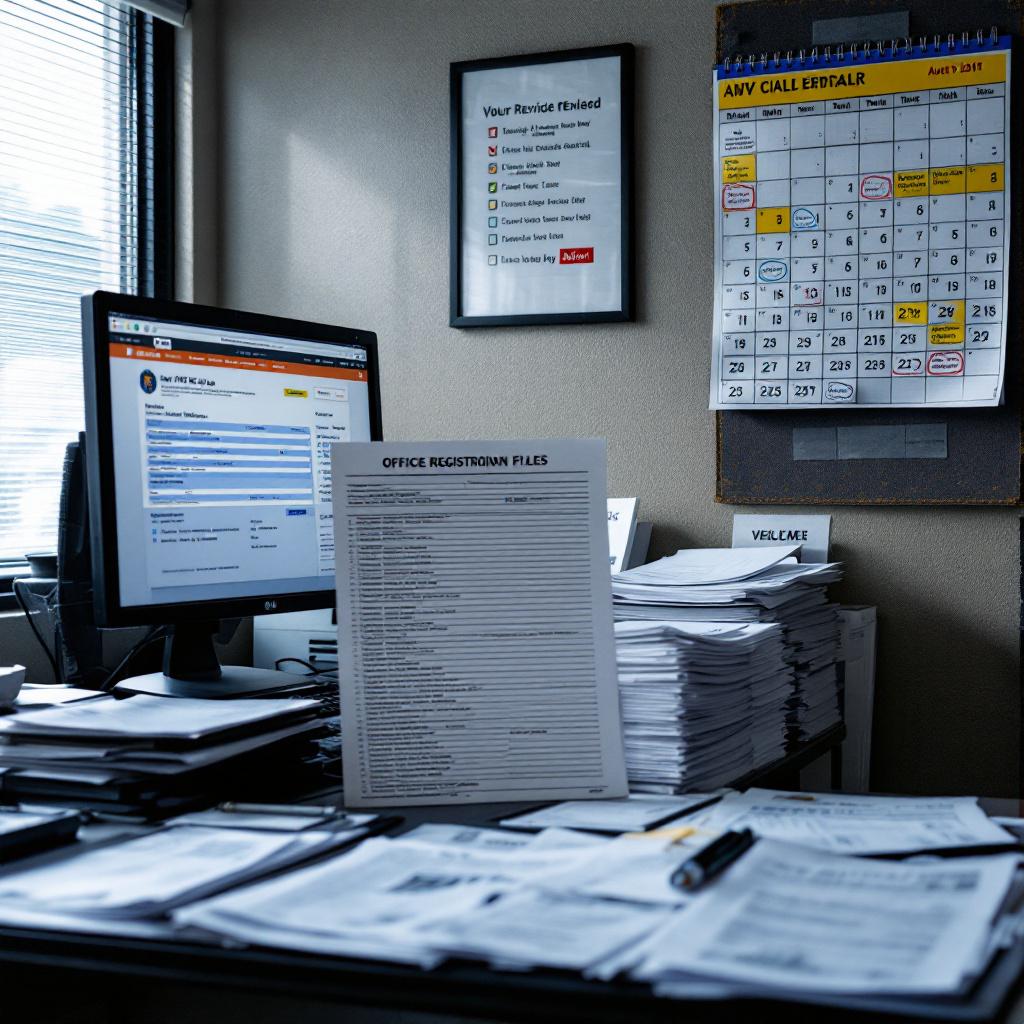

California Administrative Service Fees can turn a simple paperwork delay into a recurring compliance cost for a dealer. For DMV dealer test preparation, license renewal, and day-to-day operations, the key takeaway is simple: identify the sale date correctly, submit the Report of Sale notice on time, clear the registration application on time, and keep audit-ready proof of each step.
What California Administrative Service Fees Mean for Dealers
Administrative Service Fees, often called ASF, are DMV charges assessed to dealers and lessor-retailers when required sale reporting or registration processing deadlines are missed. They are not a customer convenience fee or a charge to build into the deal. Treat ASF as a compliance penalty that should be prevented through workflow controls.
The most common ASF risk points are:
- Late submission of the dealer notice portion of the Report of Sale.
- Late submission of the registration application and fees.
- Failure to clear a returned or incomplete application by the applicable clearing deadline.
The Sale Date Starts the Clock
ASF deadlines depend on the date of sale, so the sales and title departments must use the same definition. For the Report of Sale–Used Vehicle (REG 51), the sale date is tied to the point when the buyer has paid the purchase price, signed the purchase contract or security agreement, and taken possession or delivery of the vehicle.
Because the sale date controls multiple deadlines, do not rely only on the date the deal was booked, funded, or assigned to title staff. The compliance file should show the contract date, delivery date, and any supporting documentation that confirms when the statutory clock began.
Key ASF Deadlines Dealers Should Track
| Dealer action | Deadline trigger | ASF risk |
| Send dealer notice portion of the Report of Sale to DMV | Within five calendar days after the sale date, not counting the sale date | $5 ASF if late |
| Submit application and fees for a new vehicle | Within 20 days of the sale date | $5 ASF if late |
| Submit application and fees for a used vehicle | Within 30 days of the sale date | $5 ASF if late |
| Clear new vehicle application | Within 40 days of sale or 20 days from DMV’s first return date, whichever is later | $25 ASF if not cleared on time |
| Clear used vehicle application | Within 50 days of sale or 30 days from DMV’s first return date, whichever is later | $25 ASF if not cleared on time |
If DMV holds an application for processing beyond the allowed processing hold period described in DMV procedures, the clearing timeline may be extended. Dealers should still build internal deadlines that are earlier than the DMV deadline, because a returned application can quickly create a second ASF exposure if corrections are not handled immediately.
How ASF Charges Escalate
ASF exposure can occur in stages. A dealer may first incur a $5 fee for missing the initial notice, application, or fee submission deadline. A separate $25 fee can apply if the application is not cleared by the later clearing deadline. In practice, this means a file can be “submitted” but still create ASF if the dealer does not correct defects and clear the transaction on time.
For example, a used vehicle application submitted within 30 days may still become a problem if DMV returns it for a missing signature, incorrect vehicle description, or unreadable entry and the corrected file is not cleared by the applicable used vehicle clearing deadline. The best control is to treat every DMV return as urgent and log the first return date immediately.
REG 51 Details That Prevent Avoidable ASF
Many ASF problems start with preventable Report of Sale errors. Before submission, verify that the REG 51 and related application documents are complete, readable, and consistent with the deal file.
Pre-submission verification
- Confirm the REG 51 is used in numerical sequence and account for any voided or replacement forms.
- Verify the vehicle description, including identifying information, matches the title, application, and sales documents.
- Verify buyer name and address are accurate and consistent across the contract and DMV paperwork.
- Make sure the sale date is supported by the contract, payment, and delivery records.
- Review all handwritten entries for legibility; use clear block-style printing where handwriting is used.
- Confirm all required signatures, dealer license information, salesperson information, and fees are included.
- Check whether corrections require supporting documentation such as a Statement of Facts or other DMV-required form.
Internal Controls to Avoid ASF
Dealers can reduce ASF by building a deadline-driven title process instead of relying on memory or end-of-month cleanup. The most effective systems assign ownership, create date alerts, and document proof of timely action.
- Open the title file on delivery day. Enter the sale date, vehicle stock number, buyer name, and Report of Sale number into a central log.
- Set three deadlines at once. Track the five-calendar-day notice deadline, the application-and-fee deadline, and the final clearing deadline.
- Use earlier internal cutoffs. For example, require the notice and application package to be reviewed before the legal deadline.
- Separate review from preparation. Have a second trained employee review sale date, REG 51 number sequence, signatures, fees, and VIN consistency.
- Document submission proof. Keep mailing, processing, or electronic submission records with the deal file.
- Log DMV returns the same day received. Record the first return date, defect, assigned staff member, correction date, and resubmission date.
- Review repeat defects monthly. If the same correction causes multiple returns, update the checklist and retrain staff.
Audit-Ready ASF Checklist
Use this checklist in each retail sale file or in a title department control log. The goal is to prove what happened, when it happened, who handled it, and how any error was corrected.
| Checklist item | What to record |
| Sale date support | Contract date, payment evidence, delivery or possession documentation |
| Report of Sale control | REG 51 number, numerical sequence review, voided or in-lieu documentation if applicable |
| Five-day notice proof | Date notice prepared, date sent to DMV, staff initials, mailing or submission proof |
| Application and fee proof | Date package completed, date submitted, fee calculation, receipt or transmittal record |
| Document quality review | Vehicle description, buyer information, signatures, legibility, and form consistency |
| DMV return tracking | First return date, reason returned, correction required, correction completion date |
| Resubmission record | Date corrected package was resubmitted and proof of resubmission |
| Final clearance | Date application cleared and confirmation that no unresolved fee or correction remains |
| Repeat-fee prevention | Root cause, employee retraining, checklist update, or process change |
Practical Takeaway for Dealer Compliance
California Administrative Service Fees are avoidable when the dealership controls the calendar. Start with the correct sale date, send the Report of Sale notice within the five-calendar-day window, submit applications and fees on time, and resolve DMV returns before the clearing deadline. A clean file is not just a DMV requirement; it is evidence that the dealership had a compliance system in place.
Sources
- California DMV Vehicle Industry Registration Procedures Manual
- California DMV: Administrative Service Fees
- California DMV: Report of Sale–Used Vehicles, General Information
- California DMV: Completing the Report of Sale–Used Vehicle (REG 51)
- California DMV: Corrections on the Report of Sale–Used Vehicle (REG 51)
- California Vehicle Code section 4456.1
- California Vehicle Code section 5901


