
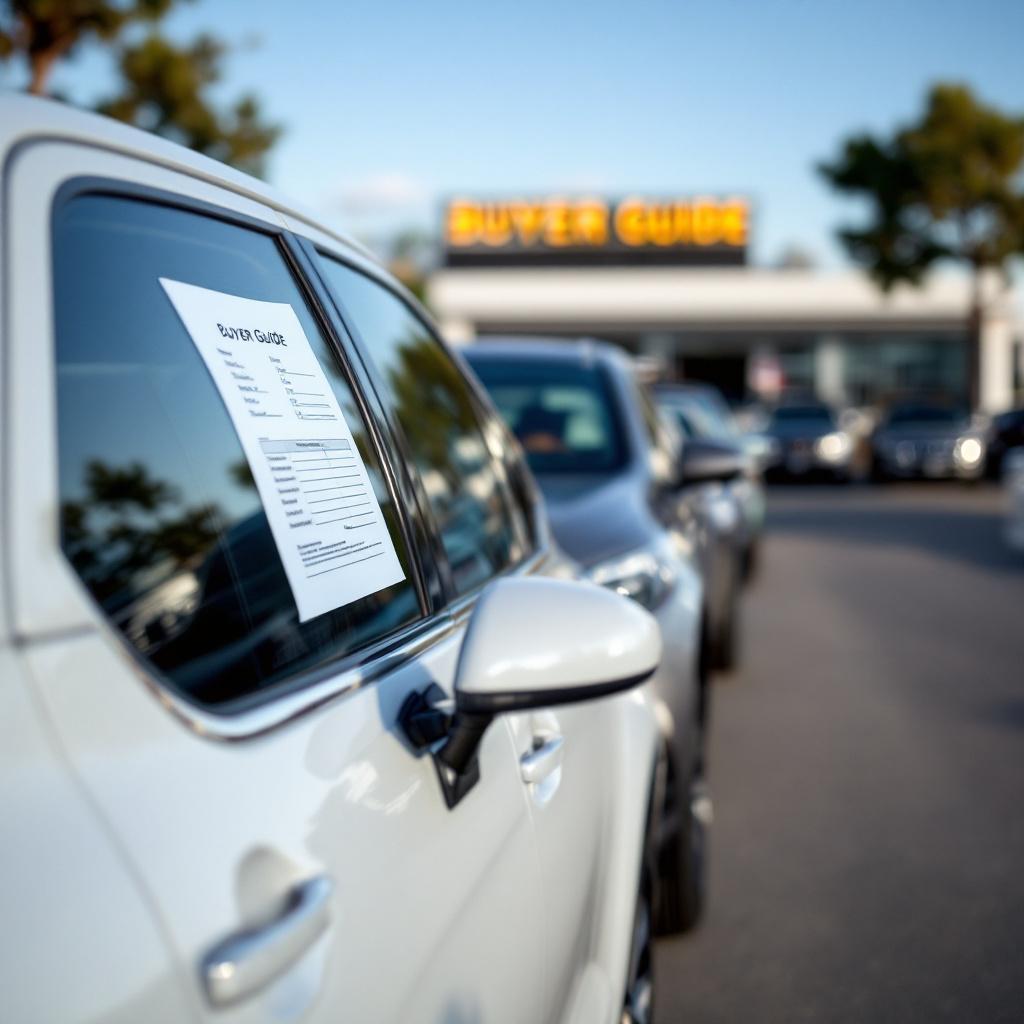

The FTC Buyer’s Guide compliance checklist is one of the fastest ways to reduce avoidable risk in your used-car operation. Under the Federal Trade Commission’s Used Car Rule, dealers must display a Buyer’s Guide on every used vehicle offered for retail sale—on your lot, at offsite sales events, and even at consumer-open auctions. Your goal is simple: post the right form, mark the right boxes, keep it visible, and file the signed copy in the deal jacket.
What the FTC Used Car Rule requires (high-level)
The FTC’s Used Car Rule requires a Buyer’s Guide to be displayed on used vehicles offered for sale to consumers. The Guide tells shoppers whether the vehicle is sold “As Is” or with a warranty, identifies major vehicle systems, and provides consumer tips such as checking for recalls.
Official FTC resources to keep bookmarked:
1) Confirm which vehicles must have a Buyer’s Guide
Generally covered vehicles
Dealer Educator training summarizes the core scope this way: the Rule applies to used motor vehicles sold to consumers when the vehicle is under 8,500 lbs. GVWR and under 6,000 lbs. curb weight. In practice, most used passenger vehicles on a retail lot will fall into this category.
Common exemptions you should recognize
Dealer Educator coursework highlights examples of exemptions such as motorcycles, off-road/farm equipment, vehicles sold for scrap/parts under a salvage certificate, private sales, and dealers who sell fewer than six used vehicles in a 12-month period.
Because exemptions can be fact-specific, use the FTC Rule and the FTC Dealer’s Guide as your final reference for edge cases.
2) Post it correctly: placement rules for lot sales and offsite events
Posting mistakes are one of the easiest ways to fail an internal audit. Dealer Educator emphasizes that the Buyer’s Guide must be:
- Affixed to a side window, hung from the rear-view mirror, or placed under the windshield wiper.
- Clearly visible from the outside, with both sides available for reading.
- Removed only for test drives and promptly replaced afterward.
Offsite sales events and consumer-open auctions
Dealer Educator teaches that the same Buyer’s Guide posting obligation follows the vehicle: if the used vehicle is being offered for retail sale to consumers at an offsite event or consumer-open auction, it still needs the Guide displayed.
California-specific reminder: offsite sales have separate DMV permitting and display requirements. For example, California Vehicle Code section 11713.4 addresses offsite and display-only advertising rules. See: California Vehicle Code § 11713.4.
3) Make the language match the deal: “As Is” vs. warranty
The Buyer’s Guide is not just a window sticker—it’s a disclosure that must match what you are actually selling. Dealer Educator highlights these key completion requirements:
- If the sale is “As Is,” the Buyer’s Guide must be marked to state that the dealer does not provide a warranty for repairs after sale.
- If the dealership provides a warranty, you must check the appropriate warranty type (full or limited) and clearly state the coverage and duration.
- If any non-dealer warranty applies (for example, a manufacturer warranty or a used vehicle warranty such as certified coverage), the relevant box should be checked.
- If a service contract is available for purchase, indicate that on the form.
Compliance tip: train your desk and F&I to treat the Buyer’s Guide as a “truth document.” If it says warranty but your contract is written as “As Is” (or vice versa), you have a documentation conflict that can create regulatory and consumer-protection problems.
4) Verify required content: what the Guide communicates to buyers
Dealer Educator training points out that the Buyer’s Guide is designed to help consumers understand the condition/warranty posture of the car and to encourage smart pre-purchase steps. The form includes:
- A warranty statement (As Is or warranty details).
- Major systems and a list of potential defects (Dealer Educator notes examples such as airbags and catalytic converters).
- Consumer tips, including checking for recalls.
Recall-check citation: the Buyer’s Guide directs consumers to check for safety recalls at NHTSA’s SaferCar site: https://www.nhtsa.gov/recalls.
5) Use the right language version when needed
Dealer Educator coursework reminds dealers that if a sale is conducted in Spanish, customers should be able to request the Spanish Buyer’s Guide. This is an easy detail to miss during high-volume events—so include Spanish forms in your offsite compliance kit and confirm your staff knows where they are stored.
6) Deal-jacket discipline: remove, sign, and file the Buyer’s Guide
Dealer Educator teaches a simple workflow at sale:
- Remove the Buyer’s Guide from the vehicle when the deal is finalized.
- Optionally have the buyer sign an acknowledgment of receipt.
- Retain a copy in the deal file (deal jacket).
Why this matters for audits: when a regulator (or your own compliance manager) asks you to prove disclosures were provided, a consistent deal-jacket process is your best friend.
Common Buyer’s Guide posting mistakes (and quick fixes)
- Guide is inside the vehicle or not readable from outside: Move it to a window, mirror hangtag, or wiper placement where both sides can be read.
- Guide missing at offsite events: Build an “event load-in checklist” that includes printing/packing Guides and verifying each retail unit is posted before gates open.
- As Is/warranty boxes don’t match the contract: Require a final “Buyer’s Guide vs. contract” check before signing.
- Guide removed for test drive and never replaced: Make “re-post the Guide” part of the test-drive return routine.
- No copy in the deal jacket: Add the Buyer’s Guide to your funding checklist and spot-check jackets weekly.
Quick self-audit workflow (15 minutes, once a week)
- Walk the line: randomly select 10 used retail units (include front-line and back-line).
- Check visibility: confirm each Buyer’s Guide is visible from outside and both sides are readable.
- Check accuracy: spot-check a few deals-in-progress to ensure the As Is/warranty selection matches what the desk/F&I is structuring.
- Check offsite readiness: confirm your event kit contains blank Buyer’s Guides (including Spanish), clips/hangers, and pens.
- Check filing: pull five funded deals and verify a Buyer’s Guide copy is in the deal jacket (and signed if your store policy requires it).
Buyer’s Guide compliance table: what to check and when
| Stage | What to verify | Who owns it |
| Vehicle is merchandised | Buyer’s Guide is posted and readable from outside; both sides visible | Inventory / lot team |
| Customer inspection & test drives | Guide is up before inspection; if removed for test drive, it is promptly re-posted | Sales team |
| Deal structuring | As Is vs. warranty language matches the actual deal terms | Desk / F&I |
| Contracting | Guide is removed at sale; acknowledgment signed per policy | F&I |
| Funding / records | Copy of the Buyer’s Guide is filed in the deal jacket | Office / compliance |
| Offsite event load-in | Every consumer-facing used unit has a posted Guide before the sale opens | Event lead / sales manager |
Bottom line for CA DMV dealer test prep
If you’re studying for the CA DMV dealer test (or renewing a license), treat the Buyer’s Guide as a “must-do, every used retail unit, every time” compliance item. Dealer Educator courses commonly test these concepts: when it must be posted, what it must communicate, and how it must be handled during test drives, offsite sales, and contracting.


